
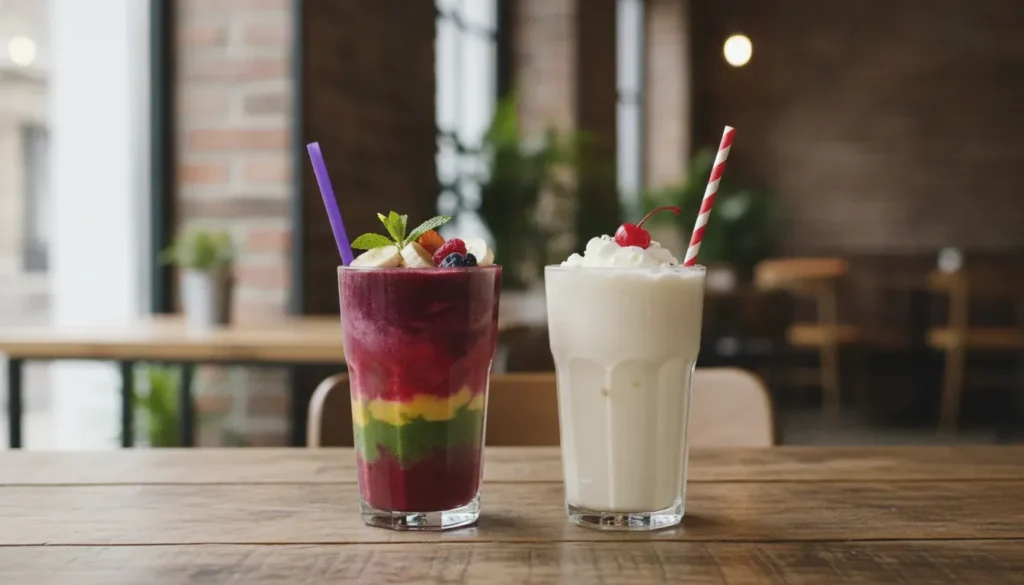
Trying to decide between a smoothie and a milkshake? The smoothie vs milkshake choice usually comes down to what forms the drink’s base, what texture you want, and whether you’re craving something fruit-forward or creamy and dessert-like. Here’s a simple way to tell them apart before you order at Milkshakes & More in Irving, Texas.
Ask us a question about your visit
Table of Contents
ToggleWhat is the quick difference between a smoothie and a milkshake?
A smoothie is commonly blended around fruit or vegetables with a liquid, while a milkshake is usually built around ice cream and milk. Those are broad descriptions, not unbreakable rules: recipes differ from one place to another, and a café’s menu may offer its own variations. Still, the base gives you a useful first clue.
In everyday terms, think fruit-forward and blended for a smoothie; think creamy, rich, and dessert-like for a milkshake. A smoothie can be thick, and a milkshake can be lightened or changed with different ingredients, so texture alone does not settle every comparison. The name and the actual ingredients both matter.
Research describing smoothies commonly characterizes them as thick, semi-liquid beverages based on fruit or vegetables. The exact formula can vary, which is one reason “smoothie” does not describe a single fixed recipe. This research on smoothie products offers an example of fruit and vegetable ingredients used in smoothie development.
| What to compare | Smoothie | Milkshake |
|---|---|---|
| Common starting point | Fruit or vegetables, blended with a liquid | Ice cream and milk, blended together |
| Typical flavor direction | Fruit-forward, sometimes with vegetable notes | Creamy, sweet, and often dessert-like |
| Texture to expect | Blended and pourable, with thickness depending on the ingredients | Usually creamy and thick, though recipes vary |
| A good fit when | You want a blended fruit- or vegetable-based drink | You want a classic ice-cream-style treat |
| Useful ordering question | “What is the base, and how thick is it?” | “What ice cream or other ingredients are in it?” |
Use the table as a starting point rather than a guarantee about every recipe. When you have a particular ingredient or texture in mind, ask what is in the drink and check the current menu before ordering.
How do the bases change the drinks?
The base is the ingredient or combination of ingredients that gives a blended drink much of its character. In a smoothie, fruit or vegetables commonly lead. A liquid helps bring the ingredients together, and other ingredients may be part of a particular recipe. The result can lean bright and fruity, mellow, or more vegetal, depending on what goes into the blender.
A milkshake generally starts from a different place: ice cream and milk create its familiar creamy foundation. Other flavors can shape the finished drink, but the ice-cream base gives a milkshake its characteristic dessert direction. At a glance, both drinks may be cold, blended, and served in a cup. Their starting ingredients set different expectations.
Do not assume that a drink’s name tells you every ingredient. A smoothie is not automatically dairy-free, and a milkshake is not the only blended drink that can be thick. If you need ingredient details, have a dietary question, or are checking for an allergen, ask the café directly. Recipes and preparation can vary, so avoid relying on a general category name to answer a specific food-safety question.
For a broad overview of how a smoothie can be made, Nutrition.gov’s breakfast smoothie recipe provides one example of a smoothie recipe. It is an example, not a definition that applies to every café drink.
What does each drink taste and feel like?
Smoothies can bring fruit flavor to the front. Depending on their ingredients, they may taste tart, sweet, mild, or more earthy. Their texture can be smooth and easy to sip, or thick enough to feel substantial. The particular combination makes a big difference: two drinks called smoothies can taste quite unlike each other.
Milkshakes usually place creamy sweetness at the center. They can feel rich and cool, with a texture that invites slower sips. The specific flavor depends on the ingredients and recipe. If you’re after a dessert-style drink, a milkshake is the more direct match. If you would rather have a blended drink whose main impression comes from fruit or vegetables, start by looking at the smoothie category.
These are flavor directions, not promises about sugar, calories, nutrition, or how filling a drink will be. Ingredients and serving sizes matter, and they are not established by the word “smoothie” or “milkshake” alone. Choose based on the experience you want, then check the actual drink details when those details matter to you.
How does texture affect the experience?
Texture is part of the difference, but it is not a reliable shortcut for identifying every drink. A smoothie is blended, so its ingredients combine into a consistent drink, yet the final thickness depends on the balance of ingredients and liquid. A fruit-heavy blend may feel dense, while another recipe may be more fluid. A milkshake’s creamy feel comes from its customary ice-cream-and-milk base, but the finished result can also vary from one recipe to another.
Think about how you plan to enjoy it. If you are carrying a drink between errands or sipping during a short break, you may prefer a texture that feels easy to drink. If you are settling in for a treat after a meal or a game, a richer shake may fit the occasion. Those are preferences, not fixed rules: some people like a thick smoothie, and others would rather have a lighter shake.
Temperature and serving pace can shape the experience too. Both categories are typically served cold, but cold does not mean the same texture or flavor. A creamy drink can feel especially rich when you sip it slowly; a fruit-based blend can put its fruit notes in the foreground. If you have a strong preference, it is perfectly reasonable to ask whether a particular option is thick, creamy, or easier to sip. A simple question can be more useful than trying to infer texture from a product name.
There is no need to choose based on an assumed nutritional effect. A fruit or vegetable base does not, by itself, tell you the full ingredients or what a drink means for your individual needs. Likewise, the word milkshake is not a complete recipe. The practical comparison is about the base and the drinking experience; for ingredient details, use the current description or ask the café.
Which one should you choose for this moment?
Start with the craving, not a rule about what one drink is supposed to be. On a warm afternoon, you might want something cold and fruit-forward; a smoothie may suit that mood. After a game or on the way home, you might be in the mood for an ice-cream-style treat; a milkshake may sound right. Either way, the best choice is the one that fits what you actually want to sip.
- Choose a smoothie as your starting point when fruit or vegetable flavor sounds appealing and you want a blended drink built around that direction.
- Choose a milkshake as your starting point when you are craving a creamy, dessert-like drink with an ice-cream base.
- Check the recipe first if you have a preferred ingredient, texture, or dietary concern. The category name is not a full ingredient list.
- Ask about thickness if you want something especially easy to sip or especially rich and substantial.
At Milkshakes & More, the choice does not have to become a debate worthy of a family group chat. The café serves both smoothies and handspun milkshakes, alongside coffee and espresso, boba teas, slushies, ice-cream desserts, and gourmet chocolates. That range can help when one person wants a fruit-based drink and another is set on a classic shake. For current options, take a look at the smoothie menu and the milkshake menu.
How can you compare them before ordering?
A few quick questions can make the choice easier without requiring a deep dive into blender science. First, ask what the drink is based on. If you are looking for fruit, find out which ingredients are featured. If you want a shake, ask what ice cream or flavors are included. Menus and recipes can change, so a current description is more useful than guessing from a name.
Here is a simple way to put that into practice. Imagine you want a cold drink after lunch, but you are not sure what sounds good. If a fruit-led flavor is the thing you are picturing, start with the smoothie choices and check the ingredients. If you are imagining a creamy dessert in a cup, look at the milkshakes. If neither description quite fits, browse the menu rather than forcing yourself to choose by label alone. The category is a helpful guide, not a test you have to pass.
Now add the practical detail that matters most to you. It could be how thick the drink is, a particular ingredient you enjoy, or a dietary question you need answered. Ask directly and let the answer guide the order. That approach also works when you are choosing for someone else: describe the flavor or texture they like, then look for a current option that matches. You do not need to know the recipe in advance to ask a useful question.
- Name the texture you want. Do you want something creamy, thick, smooth, or easier to sip? Say that plainly when asking about options.
- Choose a flavor direction. Fruit-forward and creamy-dessert are useful starting points. You do not need to know a technical recipe term.
- Check the ingredients that matter to you. If you have an allergy or another dietary requirement, ask the shop directly about ingredients and preparation. Do not assume a category guarantees a particular dietary quality.
- Look at the current menu. Product names, availability, and recipes can change. A menu listing can help you decide what to ask about.
For a quick reference to the café’s broader drink and dessert selection, visit the Milkshakes & More menu. If your group is considering other drinks too, you can also browse the café’s coffee and espresso options or its boba teas.
How can a group choose when everyone wants something different?
When friends, coworkers, or family members stop in together, each person can start with a different kind of craving. One might want something fruity, another may be in the mood for a milkshake, and someone else may prefer coffee or boba. It helps to compare the main base and flavor direction rather than trying to steer the whole group toward one “right” drink.
For example, a parent and child making a short stop after an activity might choose different categories without making the visit complicated. A colleague looking for a cold afternoon pick-me-up may browse smoothies, while a teammate celebrating the end of the workday may want a shake. These are simply different occasions and preferences; there is no need to make a wellness claim or declare one drink better.
If the group is undecided, each person can answer two questions: “What flavor sounds good?” and “What texture am I hoping for?” Then check the menu for options that line up. In a café with drinks and desserts across several categories, variety is handy precisely because everyone does not have to share the same craving.
What should you check before you go?
Check the current menu for the categories and options you want. The Milkshakes & More website is a starting point for learning about the Irving café, and the menu pages can help you compare categories. Since offerings and availability can change, confirm any specific item or ingredient directly rather than assuming it will always be available.
If you are ordering for a particular dietary need, contact the café with a clear question about the ingredients and preparation. General descriptions such as “smoothie” do not confirm that a drink meets a specific dietary standard. If the concern is allergy-related, ask directly before placing an order and make your decision based on the answer provided.
To see the location and get in touch with the shop, use the contact page. That is also a sensible place to start if you have a question that the menu does not answer.
Smoothie vs milkshake: frequently asked questions
Is a smoothie the same as a milkshake?
No. They are both blended drinks, but a smoothie commonly centers on fruit or vegetables, while a milkshake is usually based on ice cream and milk. Recipes vary, so check the ingredients when you need a precise answer.
Which drink is thicker?
Either can be thick. A smoothie’s texture depends on its ingredients and liquid, while a milkshake is often creamy and thick because of its ice-cream base. The individual recipe matters more than a blanket rule.
Is a smoothie always dairy-free?
No. The word smoothie does not guarantee that a drink contains no dairy. Ask about the particular ingredients and preparation if dairy matters to you.
Is a milkshake always made with ice cream?
Ice cream and milk are the common starting point for a milkshake, but recipes can differ. If you want to know what is in a specific drink, check its current description or ask the café.
Can I find both in Irving, Texas?
Milkshakes & More in Irving serves smoothies and handspun milkshakes, as well as other drinks and desserts. Check the current menu for available options before choosing a specific item.
Which one fits your craving?
For a fruit- or vegetable-forward blended drink, begin with a smoothie. For a creamy, ice-cream-style treat, a milkshake is the natural place to start. Compare the base, flavor, and texture you want, check the ingredients that matter, and pick the drink that sounds good to you. There is no wrong side in the smoothie vs milkshake debate—just two different ways to make a quick café stop a little more enjoyable.